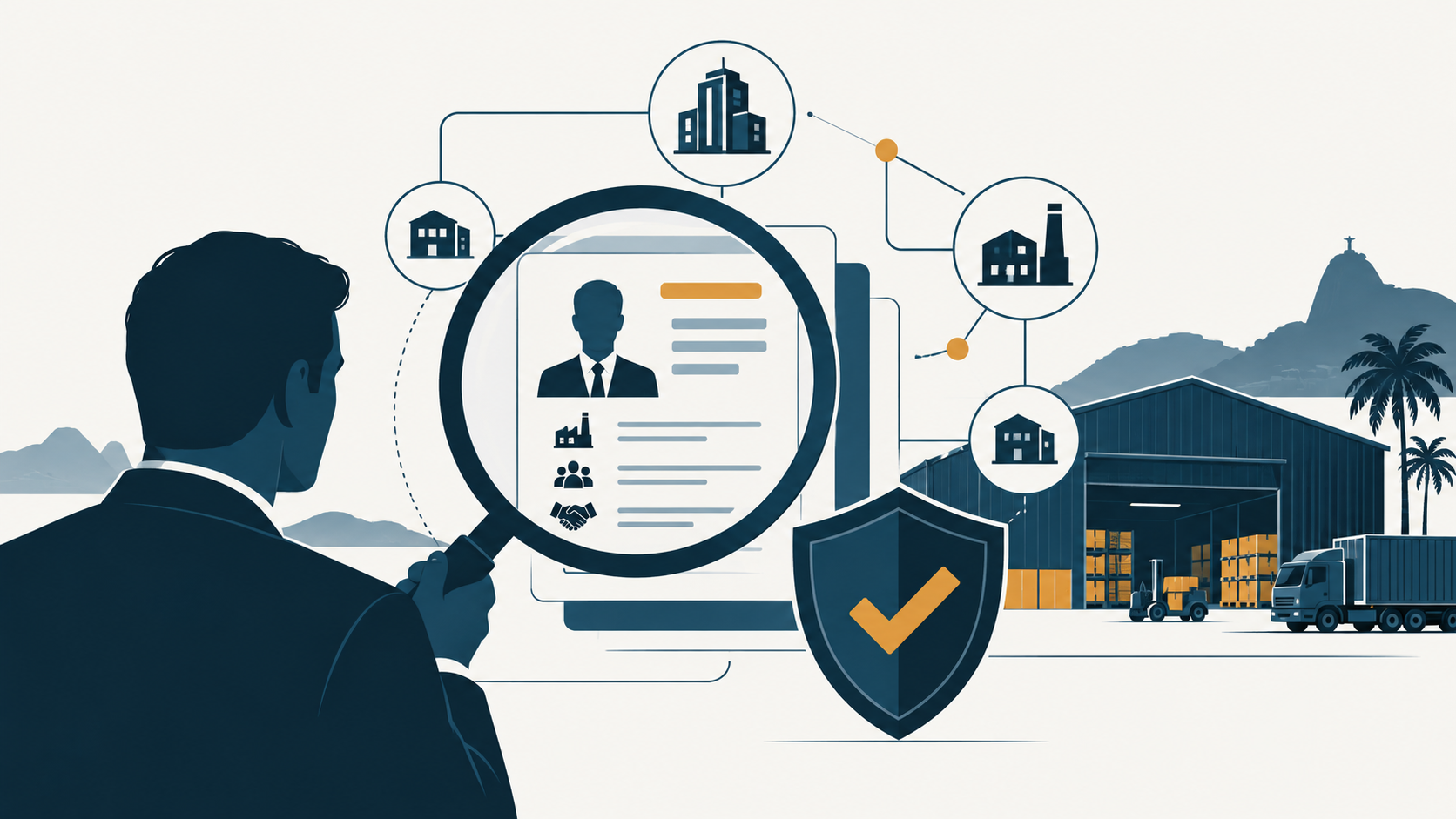
Brazilian distributor due diligence is cheap right up until you skip it. The public data trail on any Brazilian company is unusually deep — tax status, labor lawsuits, protested debts, corruption sanctions — and most of it is free to consult. Yet foreign suppliers still sign exclusive representation agreements on the strength of a good trade-show conversation and a nice office address. This checklist is the fix: what to pull, where, what it proves, and the red flags that should stop a deal.
The Brazilian distributor due diligence checklist: eight desk checks
- CNPJ card (Receita Federal). Confirm the company exists and is “ativa”, when it was founded, its registered capital, its CNAE activity codes and the partners listed in the QSA. A rep claiming twenty years in subsea whose CNPJ is eighteen months old has some explaining to do.
- Certidões negativas — the clearance certificates. Federal tax (Receita/PGFN), state tax, FGTS (the employee severance fund) and the CNDT labor-debt certificate. A company that cannot produce clean certidões cannot sign many contracts in this industry, including with Petrobras.
- Labor litigation (TST/TRT). Search the labor courts for the volume and pattern of claims against the company as employer. Some labor litigation is normal in Brazil; a claims count that rivals the headcount is not.
- Civil lawsuits. State court systems (e-SAJ, PJe) show suits by and against the company — supplier disputes, collections, contract fights with previous principals.
- Protested debts (protesto de títulos). Protests are formal registry records of unpaid obligations — one of the most direct solvency signals available.
- Sanctions lists. Check the CEIS and CNEP registers on the federal Portal da Transparência for debarment and anti-corruption penalties. A hit here is disqualifying, full stop.
- Reputation. Reclame Aqui shows complaint history and — more telling — how the company responds. Add plain search in Portuguese, not just English.
- Cross-check the story. Do the CNAE codes match what they claim to sell? Do the partners appear in other CNPJs — and what happened to those companies?
Where do these records live? The CNPJ card comes from Receita Federal; federal tax clearance from Receita and the PGFN; the FGTS certificate from Caixa; the CNDT from the labor court system; protests from the state protest registries; sanctions from the federal transparency portal. Everything is public and almost everything is free — but every interface is in Portuguese, which is why Brazilian distributor due diligence gets skipped by exactly the companies that need it most.
US$2 reports exist. They are not due diligence.
Automated CNPJ dossiers — compiled from the same registries above — are commodity products now: API marketplaces sell them for around US$2 per report. Pull one on day one; it saves hours. Just be clear about what you bought: a data snapshot. It will not tell you whether your “exclusive distributor” already carries a competitor’s line, whether the three offshore clients they name are active accounts, or whether the technical team exists outside the org chart.
The diligence that changes decisions is done by phone and on foot:
- Reference calls with two or three principals they currently represent — ask what went wrong last year, not what goes well.
- A site visit: warehouse, workshop, test equipment, actual staff at actual desks.
- A joint call on a real buyer, to see whether the claimed relationships open doors.
- Trade references on payment behavior with their own suppliers.
Red flags that should stop the deal
- CNPJ far younger than the claimed track record, or a chain of closed predecessor companies behind the same partners.
- CNAE activity codes unrelated to your product category.
- Any CEIS/CNEP sanctions or debarment record.
- Labor claims out of proportion to company size.
- Refusal to name reference clients, or references that only speak in generalities.
- Pressure to sign exclusivity before the first order.
- Requests for unusual payment routing — third-party accounts, unexplained offshore invoicing — at the first negotiation.
- “Nationwide coverage” claimed by a three-person office.
What desk checks cannot catch
Registries prove existence and record problems. They do not prove capability. The gaps below are where most representation deals actually fail — and none of them show up in a database.
| What you need to know | Desk check tells you | What actually proves it |
|---|---|---|
| Technical capability | Nothing | Site visit, staff CVs, service demonstration |
| Real market coverage | Little | Joint visits to named buyers, reference calls |
| Exclusivity conflicts | Nothing | Written disclosure of current lines + reference calls |
| Financial standing | Partial | Certidões + protests + trade references |
| Integrity | Partial | Sanctions lists + pattern across the partners’ other CNPJs |
A useful discipline: before you start, write down the three claims that made this partner attractive — “we know the Macaé operators”, “we run our own service shop”, “we cover the Northeast” — and design one verification step for each. Brazilian distributor due diligence is not a fixed report; it is the habit of testing exactly the claims you are about to pay for.
Structure the deal so diligence keeps running
Vetting does not end at signature — build it into the agreement. Start non-exclusive or region-limited. Run a 6-12 month trial with activity and volume milestones. Make exclusivity something the rep earns against performance, not a signing bonus. And get Brazilian counsel on the contract: commercial representation is specifically regulated in Brazilian law, with protections for the representative — this is not a template-contract situation.
Keep perspective, too: a good local partner is one of the main routes to selling into Brazil without your own entity, and picking the wrong one is high on our list of common mistakes foreign suppliers make. Vetting is step one of a wider plan — see our market entry budget breakdown for what the rest costs. If you want the checks run for you — registry pulls, reference calls in Portuguese, site visit with photos — that is a standing service of our advisory desk.
Frequently asked questions
How much does Brazilian distributor due diligence cost?
The registry checks are free or nearly free, and automated CNPJ dossiers cost around US$2. The real cost is skilled time: structured reference calls, a site visit and interpretation of what the records mean. That runs from a few hundred dollars outsourced to a few days of your own team’s time.
What is a CNDT?
The Certidão Negativa de Débitos Trabalhistas — a labor-debt clearance certificate issued through the labor court system. It shows whether the company has unpaid, final labor judgments. Ask for it together with the federal, state and FGTS certificates.
Should I ask for certidões before signing anything?
Yes, and do not feel awkward about it. Brazilian companies produce certidões for each other routinely — banks, landlords and large buyers all demand them. A partner who resists a standard document request is telling you something.
Can I run these checks without speaking Portuguese?
Partly. Machine translation gets you through the CNPJ card and the certidões. Court records, protest registries and complaint threads need a competent reader — nuance is the whole point of those sources. That gap is where a bilingual desk check earns its fee.
Do I really need a Brazilian lawyer for a rep agreement?
Yes. Commercial representation carries statutory protections for the representative under Brazilian law, including on termination. An agreement drafted only under your home law can cost you real money when the relationship ends.
Stop hunting tenders in Portuguese.
Tender Radar delivers Brazil’s public energy opportunities in English, matched to your product line — from US$49/month for founding subscribers.